Without Nicotine: The Product Categories for Hand and Mouth, Compared
"Nicotine free" now appears on very different things: tins of small white pouches, blisters of chewing gum, bottles of liquid for vape devices, and little herbal tins. All they really share is one missing ingredient. In composition, format, price and handling they differ a lot. This article sorts the categories and shows what you can actually compare them on.
What "nicotine free" on a pack really tells you
Nicotine free is not a product category. It is a statement about exactly one ingredient, and it says nothing about the rest — not about sugar, not about caffeine, not about flavourings, sweeteners or additives. A nicotine-free alternative can still carry a long ingredient list.
That makes the full declaration the single most useful thing to compare. Different rules apply per category: gum and lozenges are generally treated as foodstuffs and carry a food-law ingredient list, liquids for vape devices fall under their own rules, and scent or herbal products under others again. Exactly which details are mandatory depends on the category and the country — what is worth looking for in every case is a legible list in a language you understand.
The second question many people skip at the checkout: does the product need accessories, electricity or refills? Over a few months that usually matters more to the total cost than the price on the label.
Pouches without nicotine
Nicotine-free pouches are small soft pads placed between lip and gum. They are sold in round tins, typically holding 15 to 20 units. Nothing is swallowed; the used pouch goes into the lid or the bin.
The filling is usually cellulose or other plant fibres, plus flavourings, sweeteners and humectants. Some product lines also contain caffeine or added vitamins — that is printed on the tin, and it is a good reason to turn it over and read the back before buying.
On price, work out the cost per tin and per week rather than per pouch, because consumption is what drives it. Age limits and sales rules vary by country, including for nicotine-free versions — if in doubt, check the rules that apply where you are.
Gum, lozenges and mouth sprays
This is the most everyday category and the most widely stocked — gum sits on the shelf in most supermarkets. Sugar-free versions are usually sweetened with sugar alcohols such as xylitol, sorbitol or maltitol, or with sweeteners; sugared versions still exist. Either way, it is on the ingredient list.
Flavours run from mint and menthol through licorice to fruit. On format the category is about as simple as it gets: no accessories, no power, small pack sizes, low entry price.
Mouth sprays are small liquid bottles, often alcohol- or glycerine-based. For air travel they normally count as liquids in hand luggage and fall under the usual volume limits; check your airline's and the airport's current rules before you fly.
Nicotine-free vapes and 0 mg liquids
Search for a vape alternative without nicotine and you will mostly land on so-called 0 mg liquids. At their core these are usually propylene glycol, vegetable glycerine and flavourings, with no nicotine. A device heats the liquid and the resulting vapour is inhaled.
The big difference from every other category here is the hardware. You need a device with a battery, you need to charge it, and depending on the design you need consumables such as coils. Over several months those repeat purchases can outweigh the price of the device itself.
The legal picture is also moving. Several European countries have introduced their own rules for disposable devices in recent years, and age limits and sales restrictions differ from country to country. If you are ordering or travelling, it is worth checking the rules where you are.
Two practical points are worth knowing: devices with lithium batteries normally belong in cabin baggage on a flight rather than in the hold — the exact requirements are set by the airline and the airport, so check them before you fly. And end-of-life devices count as electronic waste in many countries; where that applies, they belong at a collection point rather than in household rubbish.
Scent and herbal products
The fourth group works purely through scent: inhaler sticks, herbal inhalers, smelling-salt tins and scented roll-ons. Nothing is burned, vaporised or swallowed — you open a tin or a cap and smell it.
Composition ranges from dried plant material through essential oils to isolated compounds such as menthol or borneol, which produce an intense, cool scent. Many products combine both.
In format terms this group needs the least equipment: no battery, no charging cable, no consumables, no liquid. A tin fits in a pocket, and because there is no liquid in it the hand-luggage volume limits for liquids do not normally apply — it is still worth checking your airline's and the airport's current rules before you fly.
What you can compare the categories on
Completeness of the declaration: is everything listed, including percentages? Is a contact or importer named that you can actually reach?
Cost over a month rather than per unit: factor in refills, consumables and charging, not just the first purchase.
Dependence on accessories: does it need a device, a cable, spare parts? What happens if you forget the charger?
Travel practicality: liquids in hand luggage are normally subject to volume limits, and lithium batteries to rules of their own — check your airline's and the airport's current requirements before you fly. Solid, dry products fall under neither of those two rules.
Noticeability to people nearby: vapour is visible and an intense scent is smellable — in an office, on a train or in a restaurant, that is a real point of difference.
Disposal: electronic devices and batteries generally go to a collection point, while plastic tins and blisters go through the usual recycling routes. The details are set country by country.
Where Sniffler fits into this overview
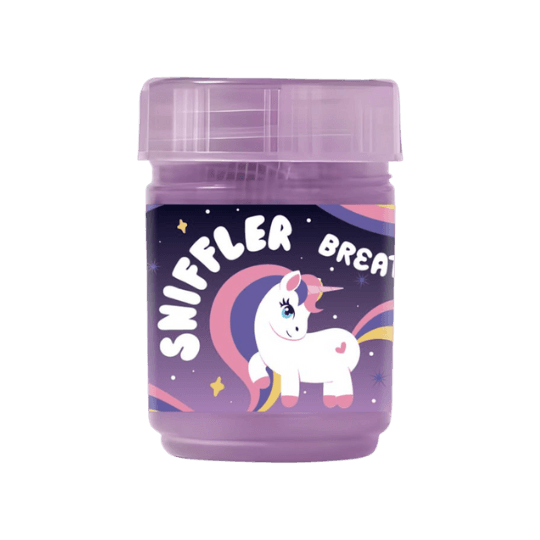
Sniffler belongs in the fourth group: a herbal inhaler in a small plastic container roughly 3.5 cm across and 5 cm tall. You open it and breathe in through the nose. Nothing is burned, nothing is vaporised, nothing is swallowed.
The blend is 87% dried plant material and 13% concentrates and essential oils, and it contains no nicotine, no caffeine and no sugar. We keep the composition openly visible: perilla/shiso stems 20%, dried eucalyptus twigs 20%, hawthorn kernels 20%, knotweed vine 7%, licorice 7%, cinnamon twig 7% and jasmine blossom 6% — plus menthol 6%, borneol 2%, eucalyptus oil 2%, rosemary oil 1%, mint/peppermint oil 1% and essential jasmine oil 1%.
In practice that means no battery, no charging cable, no consumables and no liquid subject to hand-luggage volume limits — it is still worth checking your airline's and the airport's current rules before you fly. Prices start at €9.90 for a single container, with multi-packs cheaper per unit. We ship across the EU and to further European countries, including Switzerland and the UK. For destinations outside the EU customs territory — Switzerland or the UK, for example — import charges may be added on delivery.
One point we want to be explicit about: Sniffler is not a medicinal product and not a smoking-cessation product. We do not market it as one and we make no claims of that kind. What we describe is the composition, the format and the scent — nothing beyond that.
Common questions
Does "nicotine free" mean "no additives"? No. It only means no nicotine is present. It says nothing about sugar, caffeine, flavourings or additives — for that you need the full ingredient list.
Does Sniffler contain nicotine, caffeine or sugar? No, none of them.
Is anything burned or vaporised with Sniffler? No. There is no combustion, no smoke and no vapour.
If you are pregnant, sensitive to strongly scented substances, or considering a product like this for children, speak to your doctor first. We deliberately give no recommendation on this.
Curious about Sniffler?
100% plant-based, no nicotine, no caffeine, no sugar. The full ingredient list with exact percentages is on every product page.
Sniffler is a plant-based lifestyle product, not a medicinal product. This article is general information and not medical advice.