Herbal Inhaler in Hand Luggage: What Applies When You Fly
On an ordinary day it's an unremarkable little container. At the security lane it suddenly raises a question: does this go in the clear bag? Is it even allowed in hand luggage at all? This article explains how the European rules on liquids in carry-on baggage are structured, why a solid container filled with dried herbs sits in a different category than a bottle, and what you should check yourself before departure. One thing up front: this is general information, not legal advice — what counts is the current guidance from your airport and your airline.
The 100ml rule: what it actually covers
Across the EU, carry-on liquids generally follow one common framework: individual containers may hold no more than 100 millilitres, all of them together must fit into a transparent, resealable bag of no more than one litre, and each passenger is allowed one such bag. At the checkpoint it goes through the scanner separately. The UK, Switzerland and Norway apply comparable rules, but they are separate jurisdictions with their own wording and their own updates. So check the current requirements of your airline and your airport before each flight.
The category is broader than drinks. In aviation terminology it's LAGs — liquids, aerosols, gels. That covers creams, gels, pastes, sprays, roll-on deodorant, toothpaste, syrup and sun lotion: anything that pours, spreads or sprays. Necessary medication and baby food usually follow separate procedures, which you can ask your airport about directly if you need them.
Some European airports now run CT scanners, and at times larger liquid volumes were permitted at those lanes. Those arrangements have been revised more than once and are not applied everywhere. So don't rely on somebody's account from last year — rely on the current guidance from the airport you are actually departing from.
Solid, not liquid: how a herbal inhaler is classified
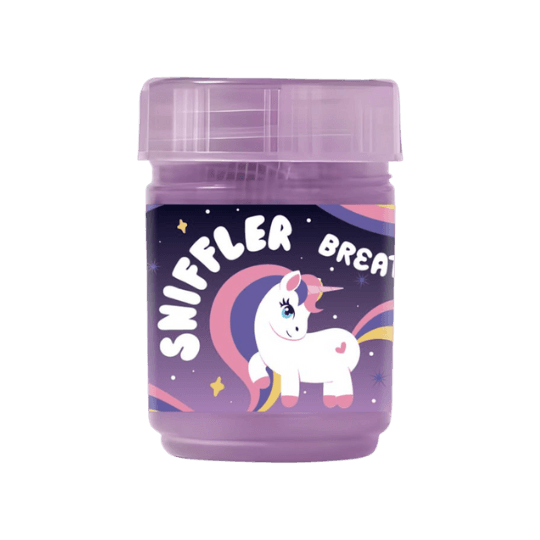
A Sniffler is a small plastic container roughly 3.5 centimetres across and about 5 centimetres tall. Inside are dried herbs, blossoms and essential oils. You open it and smell it — nothing is burned, nothing is vaporised, nothing is swallowed.
The point that matters at security: this is not a small bottle holding free liquid. The essential oils are part of the blend and sit on the plant material; there is nothing that could be poured out. On the facts, an inhaler like this is generally not what the liquids bag rule is aimed at.
Even so, the call in any individual case is made by the security officer in front of you — not by the manufacturer and not by a blog article. If you're unsure, the simplest route costs you nothing: put the inhaler in the liquids bag. It's small, it takes up almost no space, and the question is settled before anyone asks it.
Original packaging beats decanting
Take the product exactly as you received it: labelled, with the full ingredient list. With Sniffler the complete composition including percentages is printed on the packaging and shown on every product page and in the FAQ — 87 percent dried plant material (perilla/shiso stems, dried eucalyptus twigs, hawthorn kernels, knotweed vine, liquorice, cinnamon twig, jasmine blossom) and 13 percent concentrates and oils (menthol, borneol, eucalyptus oil, rosemary oil, mint/peppermint oil, essential jasmine oil).
An unlabelled jar of plant material invites questions; a labelled one doesn't. And if someone does ask, two sentences cover it: dried herbs and essential oils, not a medicinal product, no nicotine, nothing to light.
If you're carrying several units or a bulk pack, keep the receipt to hand — a copy on your phone is enough. That matters less for the security check than for customs.
Who actually sets the rules: airport, airline, country
The EU sets the framework and each airport implements it; the UK, Switzerland and Norway have comparable but separate rules, with their own wording and their own updates. That's why the same item can be handled differently in Frankfurt than in Palma or Zurich — not arbitrarily, but because equipment, procedures, legal framework and local interpretation differ.
On top of that come the airline's own rules. Those mainly concern the number, dimensions and weight of your cabin bags — points that a five-centimetre container will essentially never affect, but which you'd check before a flight anyway.
The practical routine: shortly before departure, open the hand luggage page on your departure airport's website, do the same for your airline, and if you have a connection, for the transfer airport too. Rules change, and the official source is the only one that counts.
Outside the EU: customs and plant products
Security screening and customs are two different things. Screening decides what may go on board. The customs authority of your destination decides what may be brought into the country.
Within the EU customs union, carrying it for personal use is usually straightforward. One thing to watch: not every European destination is part of it. Switzerland, the UK and Norway sit outside the EU customs union and have their own import and allowance rules. Travelling to a non-EU country, the destination's import law applies in any case, and plant products are treated strictly in some places. Countries such as Australia, New Zealand and the United States generally require you to declare plant products on the arrival form; check the current requirements with the destination's customs authority before you travel.
The rule of thumb there is simple: declare it. A declaration costs nothing and at worst leads to a brief question. Failing to declare can result in fines, however harmless the contents happen to be.
Two things that often get mixed up: Sniffler contains no tobacco, no nicotine and no alcohol, so the usual traveller allowances for those goods aren't involved. And separately, larger quantities can be treated as a commercial import — worth bearing in mind if you're travelling with a bulk pack. The destination's customs authority is the binding source.
What makes the format easy to travel with
No battery, no electronics, no charging cable. Devices with lithium batteries, e-cigarettes among them, come with their own requirements: as a rule they belong in the cabin and not in checked baggage, with the details set by your airline and airport. A herbal inhaler without a battery simply isn't covered by those rules.
There is also nothing that could leak under changes in pressure or temperature, because there is no free liquid inside. And nothing gets lit, so you don't need a lighter in your bag — which has its own set of rules again.
Whether you carry it in your cabin bag or your suitcase is up to you; in hand luggage it stays within reach. As for the scent itself: it's cool and intense. In a tight cabin seat next to strangers, it's courteous to keep the container closed unless you know they don't mind sharing it.
In short
The 100ml rule covers liquids, aerosols and gels. A solid container filled with dried herbs generally sits outside that category on the facts — and if you're in doubt, putting it in the bag anyway costs you nothing. Travel with the original packaging, keep the receipt on your phone, and check the current requirements of your departure airport, transfer airport and airline before you fly; outside the EU customs union — which includes trips to Switzerland, the UK and Norway — check the destination's customs requirements as well.
This article is general information, not legal advice. Rules change at short notice and differ between airports and countries. Current guidance from the relevant authority takes precedence over anything stated here.
If you are sensitive to strongly scented substances, are pregnant, or are considering the product for children, speak to your doctor first. We deliberately give no recommendation on this.
Curious about Sniffler?
100% plant-based, no nicotine, no caffeine, no sugar. The full ingredient list with exact percentages is on every product page.
Sniffler is a plant-based lifestyle product, not a medicinal product. This article is general information and not medical advice.