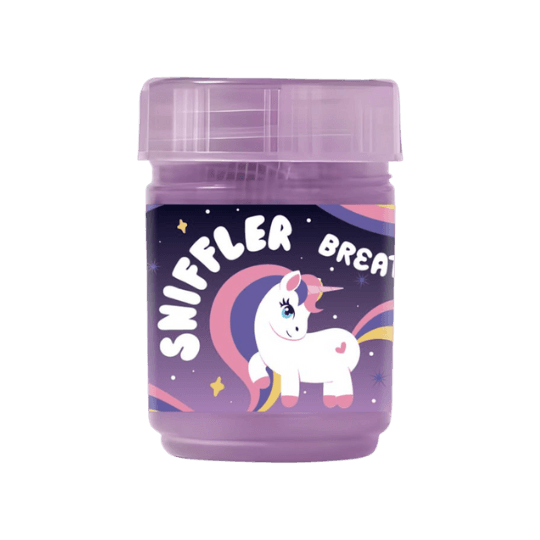
Herbal Inhaler: What It Is – and How You Actually Use One
„Herbal inhaler" sounds like something from a medicine cabinet, but the term really just describes a format: a small, portable container holding dried plant material and essential oils that you hold up and smell. The category is still fairly new in Europe and the naming is all over the place – inhaler stick, nasal inhaler, sniffing tin, herbal inhaler – which is why we get a lot of questions about it. This article explains what the category actually is, how such a product is built, what using one looks like, and what to check before buying.
What is a herbal inhaler?
A herbal inhaler is a small container holding dried herbs, flowers and essential oils. You open it, hold it briefly under your nose and breathe in. That is the entire process – nothing is burned, nothing is vaporised, nothing is swallowed and nothing is applied to the skin.
„Herbal inhaler" is not a protected or legally defined term. Quite different builds are sold under it: stick-shaped versions you hold to one nostril, and tins with an open surface. What they share is that scent is the whole point.
One thing worth being clear about: products in this category are generally everyday consumer goods, not medicinal products. Sniffler is explicitly not a medicinal product and is not sold as one. If you come across a seller making curative promises about a product like this, that is a reason to be sceptical.
The format: small enough for a pocket
Sniffler is a plastic container roughly 3.5 cm across and about 5 cm tall – small enough to close a hand around. Inside sit the dried components, combined with the essential oils in the recipe.
The practical difference to the classic stick format is handling: a stick is held to a single nostril, whereas a tin is opened and held under the nose. Either way, you close it again afterwards so the container stays sealed.
What is missing matters as much as what is there: no electronics, no battery, no heating coil, no refill cartridges, nothing to light. That means the handling stays the same everywhere – at a desk, on a train, on a hike. If you are flying: how such a container is classified in cabin baggage generally depends on the requirements that apply locally – check the current rules of your airline and your airport before you travel.
How does a herbal inhaler work?
Mechanically it is unspectacular. Dried plant material and essential oils release volatile aroma compounds into the air inside the container. While it is closed, that scent collects in the headspace above the herbs. When you open it, you smell it. That is the whole mechanism.
The character of the scent comes from the blend. In Sniffler, menthol (6%, naturally distilled from peppermint stems and leaves) and borneol (2%) drive the cool, intense side, joined by eucalyptus oil (2%), rosemary oil (1%), mint/peppermint oil (1%) and essential jasmine oil (1%). Together these concentrates and oils make up 13% of the recipe.
By volume the dried plant material dominates at 87%: perilla/shiso stems (20%), dried eucalyptus twigs (20%) and hawthorn kernels (20%), plus knotweed vine (7%), licorice (7%), cinnamon twig (7%) and jasmine blossom (6%). Licorice, cinnamon twig and jasmine blossom bring the warmer, sweeter notes. Together with the concentrates that adds up to 100% – we publish the full list with every percentage on purpose.
Scent intensity fades over time, and faster the more often and longer the container stays open. That is why there is no honest figure for how many „uses" one contains – it simply depends on how you handle it.
How you use one
Take the lid off, hold the container briefly under your nose, breathe in through the nose, close it again. That is the complete routine. There is no trick and no technique to learn.
A few things are not intended: the container is not meant to be inserted into the nose, the contents are not for the skin, not for drinks and not for the mouth. The herbs should stay inside. Keep the product out of reach of children.
On „how often and how long?" we deliberately give no recommendation. There is no dosing schedule, because there is nothing to dose. Some people pick it up once in the morning; others keep it next to the keyboard and open it now and then.
If you are sensitive to intense scents, are pregnant, or are considering the product for children, speak to your doctor first. We explicitly make no recommendation on that.
How it differs from burning, vaping and sprays
Nothing burns. There is no smoke, no ash and none of the lingering smell in fabrics you get from incense sticks. No lighter and no heatproof surface needed.
Nothing is vaporised. There is no heating coil, no battery, no liquid and no vapour – the key formal difference to e-cigarettes and vaporisers. Sniffler also contains no nicotine, no caffeine and no sugar.
Nothing is ingested. A herbal inhaler is not a tea, not a capsule and not a food supplement; it is not swallowed.
And it is not a nasal spray. Decongestant nasal sprays from the pharmacy generally contain actives such as xylometazoline or oxymetazoline and are licensed medicinal products in those cases. A herbal inhaler like Sniffler contains no such actives and does not fall into that category.
What to check before you buy
First, the ingredient list. It should be complete, legible and in a language you understand – ideally with percentages, so you can see what makes up the bulk and what is a trace component. Which language the declaration on the packaging is in can vary depending on the import route.
Second, an EU contact. Legal notice, contact address, returns policy. This matters precisely when a delivery does not arrive or you have a question about the product.
Third, shipping route and delivery time. Direct imports from overseas can take several weeks, and customs or import charges may apply depending on order value and destination country. Sniffler ships within the EU as well as to further European countries such as Switzerland, Norway and the UK. For deliveries to countries outside the EU customs union – Switzerland, Norway and the UK among them – import charges can arise in the destination country; what applies are the current rules of the customs authority there.
Fourth, the real unit price. Sniffler starts at €9.90 for a single container, with multipacks cheaper per unit. When comparing offers, always work out the price per container including shipping – otherwise a set can look far cheaper or far more expensive than it is.
Common questions
Is a herbal inhaler the same as a Thai inhaler? Not quite. Thai inhaler sticks (Ya Dom – brands like Poy-Sian, Hong Thai or Siang Pure) are their own product category with their own recipes. Sniffler is not a Thai product, though it shares individual components such as menthol, borneol, eucalyptus oil and peppermint oil. Camphor, which appears in many Ya Dom recipes, is not in Sniffler.
Is Sniffler plant-based? Yes, the recipe is 100% plant-based.
Does Sniffler contain nicotine, caffeine or sugar? No, none of them.
How long does one container last? There is no fixed figure. Scent intensity decreases over time, faster with frequent and prolonged opening. Keeping it closed helps retain the scent inside.
Curious about Sniffler?
100% plant-based, no nicotine, no caffeine, no sugar. The full ingredient list with exact percentages is on every product page.
Sniffler is a plant-based lifestyle product, not a medicinal product. This article is general information and not medical advice.