Menthol and Borneol: Where These Substances Come From
Among all the dried plant material on the Sniffler ingredient list, two names sound more like a laboratory than a herb garden: menthol (6%) and borneol (2%). Neither is a modern industrial invention, though — both occur naturally in plants and can be extracted from them. This article explains where they come from, how they are produced, what they smell like, and why scented products almost always use them in small proportions.
Menthol: a compound from the mint plant
Chemically, menthol is a monoterpene alcohol with the formula C10H20O. At room temperature it isn't an oil but a colourless, crystalline solid — you can genuinely hold it as small needles or flakes. It only melts at higher temperatures.
In nature, menthol occurs mainly in mint species: peppermint (Mentha × piperita) and corn mint (Mentha arvensis), also known as Japanese mint. How much menthol a plant's essential oil contains varies considerably with species, growing location, weather and harvest timing — growing herbs is agriculture, not a fixed recipe.
One curiosity: menthol exists in several mirror-image forms, called isomers. Only one of them — L-menthol — carries the scent most people associate with mint: clear, cool, penetrating, with a faintly sweet note underneath. The other isomers smell noticeably different and are rarely used for scent purposes.
How natural menthol is obtained
The classic route is steam distillation. The harvested plant parts — in Sniffler's case peppermint stems and leaves — are treated with steam, which releases the essential oil from the plant material. The oil is collected and then cooled.
The decisive step happens during cooling: the menthol crystallises out of the oil. Those crystals are separated from the remaining liquid and purified further. What's left is a mint oil with a much lower menthol content, which is usually put to further use — so relatively little of the starting material goes unused.
The yield is still small. A large quantity of fresh plant material produces comparatively little crystal. That's one reason menthol rarely appears in large proportions in a formulation, and why the world price for plant-derived menthol depends heavily on harvests and acreage.
Natural or synthetic: what actually differs
A substantial share of the menthol used worldwide today is not extracted from mint but produced synthetically, typically starting from raw materials such as thymol or citronellal. The end result is the same molecule found in the plant.
So the difference lies not in the molecule but in the raw material, the production route, the supply chain, the price and the availability. Plant-derived menthol depends on harvests, weather and growing areas; synthetic menthol does not and can be planned year-round. Both are common routes in the fragrance and flavour industry.
For shoppers this is hard to spot, because either way an ingredient list simply says "menthol". The name alone tells you nothing about origin. That's why we state explicitly that the menthol in Sniffler is of natural origin, distilled from peppermint stems and leaves.
Borneol: the compound named after an island
Borneol is named after Borneo. It became known in Europe largely through trade in the resin of the tree Dryobalanops aromatica, which grows on Borneo and Sumatra. The resulting product was long called "Borneo camphor" and was for a long time a significant trade good in Southeast Asia.
Borneol is far from limited to that source, though. It occurs in small amounts in numerous essential oils, including rosemary, ginger and conifer oils. And like menthol it can also be produced synthetically, usually starting from terpenes such as pinene or camphene derived from conifer resins.
Chemically, borneol is a close relative of camphor: oxidising borneol yields camphor. The two should not be confused all the same — they are different substances. Sniffler contains borneol only, no camphor.
In scent terms, borneol is heavier and drier than menthol: woody, resinous, with an earthy edge and a camphorous undertone. In Chinese the substance is called bingpian (冰片, roughly "ice flakes") — a name that refers to the thin, flake-shaped crystals it forms.
How both are used in scented products
You meet menthol more often than you might think: in toothpaste, chewing gum, mouthwash, confectionery, cosmetics, and in perfumery, where it can give a composition a clear, cool top note. Borneol is far less common and appears mainly in incense, in East Asian scent blends, and in small amounts in perfumery.
What they share is intensity. A few percent already shapes the overall character of a blend, and more is not automatically better — too much simply drowns out everything else. That's why formulations almost always keep them in single-digit percentages.
Sniffler works the same way: 6% menthol and 2% borneol set the cool, clear top note, while the dried botanicals contribute the quieter, warmer ones — licorice, cinnamon twig and jasmine blossom among them.
Menthol and borneol inside Sniffler
On paper, Sniffler is above all a herbal blend: 87% of the recipe is dried plant material — perilla/shiso stems (20%), dried eucalyptus twigs (20%), hawthorn kernels (20%), knotweed vine (7%), licorice (7%), cinnamon twig (7%) and jasmine blossom (6%).
The remaining 13% are the concentrated scent components: menthol (6%), borneol (2%), eucalyptus oil (2%), rosemary oil (1%), mint/peppermint oil (1%) and essential jasmine oil (1%). Together that adds up to exactly 100% — we publish the full list with all percentages on every product page.
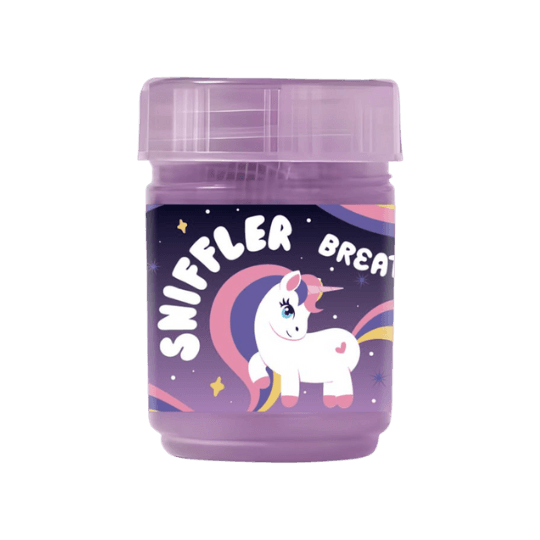
In the finished product all of this sits in a small container roughly 3.5 cm across and 5 cm tall. You open it and breathe in through the nose. Nothing is burned, vaporised or swallowed. Sniffler contains no nicotine, no caffeine and no sugar, and it is not a medicinal product.
Prices currently start at €9.90 for a single unit, with lower unit prices for larger packs. We ship across the EU and to further European countries, including Switzerland and the UK; the countries currently selectable are shown at checkout. For deliveries outside the EU customs territory — Switzerland, the UK or Norway, for example — additional import charges may apply depending on the destination, and the rules of the respective country are what count.
Common questions
Does natural menthol smell different from synthetic menthol? The L-menthol molecule is the same in both cases. Plant-derived menthol may, depending on how far it is purified, carry traces of other plant components that marginally affect the overall impression.
Is borneol the same as camphor? No. The two are chemically closely related but not identical. Sniffler contains borneol and no camphor.
Why do some products just say "menthol" with no origin stated? Because naming the substance generally doesn't require stating how it was obtained — which details are mandatory depends on the product category and the applicable law. If origin matters to you, it's worth asking the seller.
If you are sensitive to strongly scented substances, are pregnant, or are considering the product for children, speak to your doctor first. We deliberately give no recommendation on this.
Curious about Sniffler?
100% plant-based, no nicotine, no caffeine, no sugar. The full ingredient list with exact percentages is on every product page.
Sniffler is a plant-based lifestyle product, not a medicinal product. This article is general information and not medical advice.