Nasal Spray vs. Herbal Inhaler: The Difference in Composition
"Nasal spray alternative" is one of the search terms that brings people to our shop. Understandable – a herbal inhaler and a nasal spray look like two versions of the same idea: small, pocketable, something to do with your nose. Factually they are two separate product categories with completely different compositions, different legal status and different places to buy them. This article puts them side by side, purely on the level of ingredients, format and availability.
What's inside a decongestant nasal spray
Decongestant nasal sprays sold in pharmacies are medicinal products. Their core component is a clearly defined active ingredient – usually xylometazoline hydrochloride, oxymetazoline hydrochloride or tramazoline hydrochloride. These substances belong to the alpha-sympathomimetic group and are pharmacologically active.
The amount is precisely fixed. The strength is normally printed on the pack as a percentage, and each pump delivers a metered dose. Dosage, indications and warnings usually appear in the patient information leaflet – part of what marketing authorisation as a medicine requires.
Alongside the active, such a spray contains excipients: purified water, salts to adjust pH and osmolarity, sometimes additives such as glycerol or dexpanthenol, and often a preservative such as benzalkonium chloride. Preservative-free versions also exist.
A separate sub-category is isotonic sea-water and saline sprays. They contain no decongestant active, essentially just a salt solution, and are usually placed on the market as a medical device or cosmetic. But when people search for the active ingredient of a decongestant nasal spray, they almost always mean the first group.
What's inside a herbal inhaler
A herbal inhaler has no active-ingredient list in that sense – it has a recipe of plant material. For Sniffler it reads: perilla/shiso stems 20%, dried eucalyptus twigs 20%, hawthorn kernels 20%, knotweed vine 7%, licorice 7%, cinnamon twig 7%, jasmine blossom 6%, menthol 6%, borneol 2%, eucalyptus oil 2%, rosemary oil 1%, mint/peppermint oil 1%, essential jasmine oil 1%.
That makes 87% of the blend dried plant parts – stems, twigs, kernels, vine, bark and blossom. The remaining 13% are essential oils plus two isolated natural compounds: menthol, distilled from peppermint stems and leaves, and borneol.
There is no nicotine, no caffeine and no sugar in it – and none of the decongestant actives listed above. Sniffler is not a medicinal product.
We publish the full recipe with exact percentages on every product page. That's deliberate: with something you hold to your nose, you should be able to read what's in it without having to email anyone.
Liquid or dry: the difference in format
A nasal spray is a liquid in a pump bottle with a metering unit. The applicator goes into the nostril and the liquid is sprayed in. Format and method of use are part of the respective authorisation.
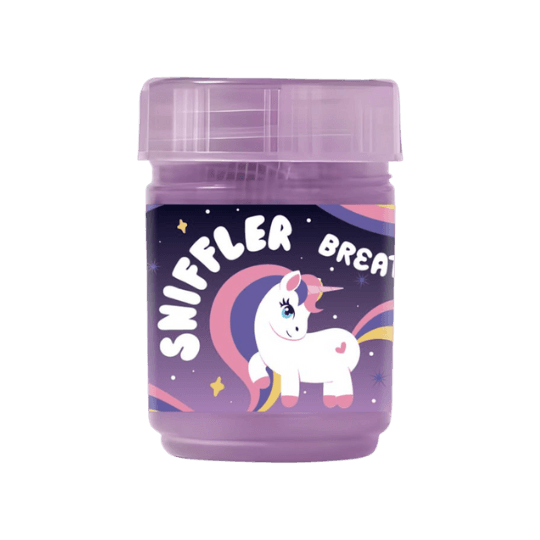
Sniffler is a small plastic container, roughly 3.5 cm across and about 5 cm tall, filled with the dry herbal blend. You open it, breathe in through your nose, and close it again. Nothing is sprayed, nothing is burned, nothing is vaporised and nothing is swallowed.
So there is no metering unit, no applicator and no liquid that could leak. What's left is an intense, cool scent of menthol, eucalyptus and dried herbs – and that's as much as we'll describe.
Medicine or not – the difference that matters
A decongestant nasal spray is an authorised medicine. That normally means an authorisation number, a leaflet listing indications and contraindications, batch-tested quality – and, at the pharmacy counter, someone qualified to advise you on it.
Sniffler is explicitly not a medicinal product. That's why we make no health-related claims about it. We describe the composition, where the recipe draws from, the format and the scent – and nothing beyond that.
Which leads to the key point of this comparison: the two are not interchangeable, and we deliberately do not position Sniffler as a substitute for a nasal spray. If you have a medical need, the right address is a pharmacist or a doctor – not an online shop for herbal products.
Price, availability and travel
Nasal sprays containing the actives named above are sold through pharmacies and online pharmacies; the price depends on the active, the fill volume and the manufacturer.
Sniffler starts at €9.90 for a single inhaler, with larger packs costing less per unit. We ship across the EU as well as to Switzerland and the UK. Switzerland, the UK and Norway are outside the EU customs union, so import charges or additional formalities may apply there. It's worth checking the applicable customs rules before you order.
One practical difference matters when flying: liquids in hand luggage are generally restricted to containers of up to 100 ml in a transparent bag, with exemptions foreseen for medicines needed during the journey. A dry herbal blend in a closed container is not a liquid. What counts, though, are always the current rules of your airline and the airport in question – check them before you fly. For travel to countries outside the EU it's also worth checking local import rules for plant products.
If you're unsure
Sniffler smells intense – menthol, eucalyptus oil and borneol are powerful scent components. If you are sensitive to strongly scented substances, are pregnant, or are considering the product for children, speak to your doctor first. We deliberately give no recommendation on this.
That's exactly what the open ingredient list is for: print it out or show it on your phone when you ask at a pharmacy or a practice.
Common questions
Is a herbal inhaler an alternative to a nasal spray? No. They are two different product categories with different compositions and different legal status. The search term "nasal spray alternative" often leads to herbal products because both are small and involve the nose – but in content they have little in common.
Does Sniffler contain xylometazoline or oxymetazoline? No, neither of those actives, and no tramazoline either.
Is Sniffler only available from pharmacies? No. Sniffler is not a medicinal product and is sold directly in our shop as a plant-based product.
Is anything sprayed, burned or vaporised? No – the container holds only dried herbs, blossoms and essential oils.
Curious about Sniffler?
100% plant-based, no nicotine, no caffeine, no sugar. The full ingredient list with exact percentages is on every product page.
Sniffler is a plant-based lifestyle product, not a medicinal product. This article is general information and not medical advice.