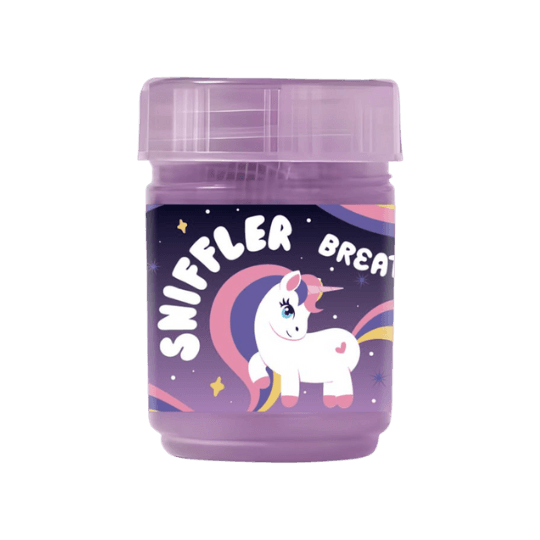
Perilla, Hawthorn, Knotweed: The Plants Inside Sniffler
There are thirteen entries on the Sniffler ingredient list. Most of them are plants — and not the obvious ones from the herb shelf, but stems, twigs, kernels and vines. This article works through the list: what each plant is botanically, where it grows, which part goes into the container, and what it smells like. This is strictly about botany, origin and scent — not about effects. Sniffler is not a medicinal product, and we do not attribute the properties of one to it.
The blend in numbers
Roughly 87 percent of Sniffler is dried plant material. The remaining 13 percent are concentrated components: menthol, borneol and four essential oils.
The full recipe: perilla/shiso stems 20%, dried eucalyptus twigs 20%, hawthorn kernels 20%, knotweed vine 7%, licorice 7%, cinnamon twig 7%, jasmine blossom 6%, menthol 6%, borneol 2%, eucalyptus oil 2%, rosemary oil 1%, mint/peppermint oil 1%, essential jasmine oil 1%.
That adds up to exactly 100 percent. We publish these figures in full — on every product page, in the FAQ and here. That way you can do the arithmetic yourself and judge what you are buying, rather than having to rely on a collective term like "herbal blend".
Perilla / shiso stems (20%)
Perilla frutescens is an annual member of the mint family, closely related to mint, basil and sage. In Japan it is called shiso, in Korea kkaennip, in China zi su. It grows fast, reaches close to a metre in height and comes in a green and a red-purple variety.
In East Asia it is an everyday culinary herb: green leaves are served under sashimi, red ones colour pickled umeboshi plums, and in Korea the leaves are pickled or used as a wrap for rice. It is now also cultivated in Europe, including in Dutch and Italian greenhouses.
What goes into Sniffler, however, is not the leaf but the stem — the woody, angular part usually trimmed off in the kitchen. Dried, it smells far more restrained than the fresh leaf: herbaceous and dry, with a faint aniseed note underneath. If you have ever rubbed a fresh shiso leaf, you will recognise the direction, just muted.
Dried eucalyptus twigs (20%)
Eucalyptus is a genus in the myrtle family with more than 700 species, almost all of them native to Australia. It is now grown across warm regions worldwide — in Portugal and Spain, South Africa, Brazil and China. Some species are among the fastest-growing trees there are.
Sniffler uses the twigs, not the leaves alone and not only the distilled oil. Pieces of twig are coarser and firmer than shredded leaf material, and they release their scent more slowly.
The smell is the eucalyptus character you would expect: fresh, resinous, clear — but noticeably milder than neat eucalyptus oil. On top of the twigs, the recipe also contains 2% eucalyptus oil in concentrated form.
Hawthorn kernels (20%)
Hawthorn (Crataegus) belongs to the rose family and is one of Europe's most ordinary shrubs: it stands in field hedges, along woodland edges and in old boundary banks. In May it carries dense white, sometimes pink-tinged flower clusters; in autumn, small red pome fruits. The branches are thorny and the wood is exceptionally hard, which is why hawthorn was historically planted as a living fence.
Inside each of those red fruits sit one to five hard stones. Those are what is meant by hawthorn kernels here — not the flesh of the fruit and not the blossom.
In scent terms the kernels are the quietest component in the whole blend: very dry, faintly nutty and woody, with no peak of their own. At 20 percent they match perilla and eucalyptus by volume, but what they mainly contribute is structure and coarseness rather than aroma.
Knotweed vine (7%)
A clarification is worth making here, because the word carries baggage in Europe. This is Polygonum multiflorum, a climbing knotweed from central and southern China — not Japanese knotweed, the invasive species that spreads along railway embankments and riverbanks across Britain and the continent. Both sit in the knotweed family, but they are different species with entirely different growth habits.
Polygonum multiflorum is a perennial climber with heart-shaped leaves and small whitish flower panicles that winds its way up shrubs and fences. In East Asia the root and the vine each carry their own name — they are two visibly different parts of the plant.
Sniffler uses the vine — the woody stem of the climber, cut into pieces and dried. It smells earthy and woody, with a very quiet sweetness underneath.
Licorice (7%)
Licorice (Glycyrrhiza glabra) is a legume, related to peas and beans. The shrub originates in the Mediterranean and western Asia and is cultivated today in Spain, Italy, Turkey and Central Asia among other places. The part harvested is the root, which can reach a metre down into the soil.
The name says it: glycyrrhizin, the compound in the root, is many times sweeter than table sugar. It is what liquorice confectionery is built on, from soft Dutch drop to Finnish salmiak. Licorice is also a fixture in herbal and spiced tea blends.
One point of context: nothing is swallowed with Sniffler. The dried root pieces contribute to the smell only — sweet and earthy, with an aniseed edge. Sniffler contains no sugar.
Cinnamon twig (7%)
Most people know cinnamon as ground bark. The cinnamon tree belongs to the laurel family; the main distinction is between Ceylon cinnamon (Cinnamomum verum) from Sri Lanka and cassia cinnamon (Cinnamomum cassia) from southern China and Vietnam.
Sniffler does not use the bark but the twig: the young, thin shoots of the tree, cut into short pieces. Twig and bark are two separate materials in the trade, with their own names, their own structure and their own processing.
The cinnamon direction is still recognisable in the scent, but much softer than ground cinnamon: warm and woody-sweet, without the sharp edge the bark has.
Jasmine blossom (6%)
Jasmine belongs to the olive family, making it a botanical relative of the olive tree and lilac. For scent purposes the relevant species are mainly Jasminum sambac and Jasminum grandiflorum, grown in China, India and Egypt among other places.
Jasmine flowers at night: the buds open in the evening, which is why the blossoms are classically picked by hand after dark or in the early morning. In China's Fujian province they are then layered overnight with green tea so the tea takes on the scent — that is how jasmine tea is made.
Sniffler contains the dried blossoms at 6%, plus 1% essential jasmine oil. The scent is intensely floral and sweet with a slightly fruity facet — the counterpoint to the cool, clear components of the blend.
Menthol, borneol and the essential oils
The concentrated 13 percent are quickly explained. Menthol (6%) is the largest single component in this group. It is naturally derived, distilled from the stems and leaves of peppermint (Mentha × piperita), itself a cross between water mint and spearmint. Menthol smells cool and penetratingly clear.
Borneol (2%) is a terpene alcohol that occurs naturally in rosemary, cinnamon and in the resin of several Southeast Asian trees. Its smell is dry and cool. Despite the chemical kinship, borneol is not the same thing as camphor — and camphor, which some other inhaler sticks list among their ingredients, is not part of Sniffler.
Then come eucalyptus oil (2%), rosemary oil (1%), mint/peppermint oil (1%) and essential jasmine oil (1%). Rosemary (Salvia rosmarinus) is an evergreen sub-shrub of Mediterranean coastlines; its oil is steam-distilled from the needle-shaped leaves and smells herbaceous and resinous.
Why stems, twigs and kernels?
Read the list as a whole and a pattern emerges: perilla stem instead of perilla leaf, eucalyptus twig instead of eucalyptus leaf, cinnamon twig instead of cinnamon bark, hawthorn kernel instead of hawthorn blossom. The blend is built mostly from coarse, woody plant parts.
Such parts are firmer and less fine than leaves or petals, and they hold their structure inside a small container rather than collapsing into powder. The container itself is around 3.5 cm across and 5 cm tall — you open it and smell it. Nothing is burned, vaporised or swallowed.
In practice that also means what you see when you look inside are recognisable pieces of plant, not a homogeneous mass. That is deliberate.
What is not in it — and one note
Sniffler contains no nicotine, no caffeine and no sugar. There is no camphor in it. It is not a medicinal product, and we deliberately make no statements about any effect.
If you are sensitive to strongly scented substances, are pregnant, or are considering the product for children, speak to your doctor first. We expressly give no recommendation on this.
Prices start at €9.90 for a single container, with larger packs cheaper per unit. We ship across the EU as well as to Switzerland and the UK. The full composition with all percentages is listed on every product page.
Curious about Sniffler?
100% plant-based, no nicotine, no caffeine, no sugar. The full ingredient list with exact percentages is on every product page.
Sniffler is a plant-based lifestyle product, not a medicinal product. This article is general information and not medical advice.