Riechstift, Inhalierstift, Naseninhalator: What the German Terms Actually Mean
Shop for small herbal containers in German-language stores and you will run into at least four words: Riechstift, Inhalierstift, Naseninhalator and Schnupfstift. They get used interchangeably, but in everyday practice they do not mean quite the same thing — and none of them reliably tells you what is inside a product or how it is classified. This article sorts the vocabulary out, explains the physical difference between stick, jar and roll-on, and shows what is actually worth comparing.
Riechstift: the everyday umbrella term
Riechstift translates literally as “smelling stick”, and that is exactly what it describes. It is one of the most common colloquial German words for the slim plastic sticks familiar from Thailand — typically seven to nine centimetres long, with a screw or push cap and an absorbent core soaked in essential oils.
The key point: the word describes only the shape and the way you use it. It says nothing about which substances are inside, in what concentration, or whether the item is a cosmetic, a lifestyle product or an approved medicine.
That is why one search term returns wildly different goods side by side: imports from South-East Asia, European own-brands, pharmacy products and scent accessories with no herbal content at all.
Inhalierstift: same format, more technical wording
Inhalieren simply means to breathe in. Inhalierstift is therefore largely a synonym for Riechstift, but it sounds more technical and shows up more often in product titles, pharmacy ranges and catalogue copy than in spoken German.
It pays to look twice here, because two legally very different groups sit under this one label. Some pharmacy products in this format are approved medicines and then usually carry a marketing authorisation or registration number, medicinal-product labelling and a package insert. Other products in exactly the same format are explicitly not medicines. A German pharmaceutical number (PZN) does not separate the two groups, by the way — it is also issued for cosmetics, food supplements and medical devices listed through pharmacies.
The word itself does not distinguish between them. If that difference matters to you, you will only find it on the packaging and in the product description — never in the name.
Naseninhalator: the broadest and blurriest term
Naseninhalator sounds like the most precise word of the four. In practice it is the widest. It is used for the small pocket sticks, but it turns up just as often for entirely different product classes.
Search for it and you will often be shown plastic steam inhalers, electric nebulisers and accessories from the medical-device world — items that have nothing to do with a pocket format, measure several centimetres across and are used in a completely different way.
So when you compare offers, first check whether the same product category is even being discussed. A glance at the dimensions, the fill quantity and the product photos settles it in seconds.
Schnupfstift: the rarest word, and the most frequent mix-up
Schnupfstift is regarded as the oldest of the four terms and is fairly rare today. It comes from the verb schnupfen, meaning to take something up through the nose.
This is where a mix-up regularly happens, and it is worth knowing about: snuff (Schnupftabak) is something entirely different. Snuff is a tobacco product, taken as a fine powder into the nose, and it contains nicotine. Herbal sticks and herbal jars, by contrast, are not tobacco products. Sniffler contains no nicotine and is not introduced into the nose at all — you hold the jar in front of it and breathe in.
If a listing blends both worlds of vocabulary, read the ingredient list especially carefully.
Stick, jar, roll-on: the three formats compared
The stick is the best-known format: slim, capped, with a soaked carrier material inside. It fits any pocket and opens one-handed. You usually cannot see the carrier material itself.
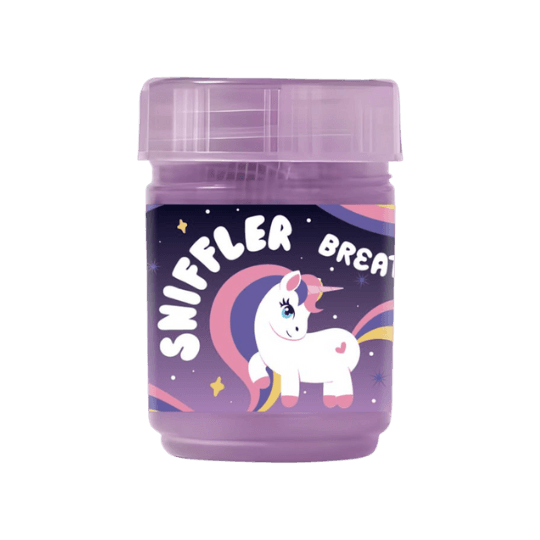
The jar is wider and shorter, with a screw or click lid, and holds loose dried plant material that you can actually see when you open it. Sniffler belongs to this group: roughly 3.5 centimetres in diameter and about 5 centimetres tall. The upside is a visible content; the downside is a bulkier shape than a stick.
The roll-on is the third variant and works on a different principle entirely: it holds liquid oil with a ball in the closure, applied to the skin. Some product lines combine both — a stick to smell at one end, liquid oil at the other. Check which kind of use a product is designed for before you compare prices.
Why the wording matters when comparing
None of the four terms is protected or standardised. Two shops can use the same word for very different goods, and in practice that does happen. So do not rely on the label; rely on five concrete checks.
First: is there a complete ingredient list, ideally with percentages, in a language you can read? The language printed on the packaging can vary depending on the import route. Second: is the product marked as a medicine, or explicitly not one? Third: how much is actually inside, and what does a single unit cost — not the bundle price?
Fourth: is the product meant to be smelled or applied to the skin? Fifth: is there a reachable contact or importer in the EU, and how long does shipping take? Direct imports can take several weeks, and customs or import charges may apply depending on the destination country and the order value. This is not uniform within Europe either, since Switzerland, the United Kingdom and Norway are not part of the EU customs union. The safest step is to check the current rules with the customs authority of your own country.
Where Sniffler fits in
Plenty of customers search for Riechstift and end up with us, so let us be precise: Sniffler is not a stick, it is a jar. Roughly 3.5 centimetres in diameter, about 5 centimetres tall, filled with dried herbs, flowers and essential oils. You open it and breathe in through your nose. Nothing is burned, vaporised or swallowed.
Sniffler is 100% plant-based, contains no nicotine, no caffeine and no sugar, and is not a medicinal product. We keep the composition openly visible on purpose. Dried plant material accounts for 87%: perilla/shiso stems 20%, dried eucalyptus twigs 20%, hawthorn kernels 20%, knotweed vine 7%, licorice 7%, cinnamon twig 7%, jasmine blossom 6%. The remaining 13% are concentrates and oils: menthol 6%, borneol 2%, eucalyptus oil 2%, rosemary oil 1%, mint/peppermint oil 1%, essential jasmine oil 1%.
Sniffler is also not a Thai product and is not sold as one. Four components — menthol, borneol, eucalyptus oil and peppermint oil — also appear in Thai Ya Dom formulations; Sniffler contains no camphor. Prices start at €9.90, with delivery across the EU, Switzerland and the UK.
Common questions
Are Riechstift and Inhalierstift the same thing? Colloquially, more or less yes. Both words describe the format and the way it is used, not the contents and not the legal classification.
Is a Naseninhalator a nasal spray? No. A nasal spray from the pharmacy is a liquid that is sprayed into the nose; depending on the product, such preparations contain actives such as xylometazoline or oxymetazoline. Sniffler contains no such actives and is not a medicinal product.
How can I tell whether a product is a medicine? Usually by a marketing authorisation or registration number, a package insert and the corresponding medicinal-product labelling on the pack. A PZN on its own proves nothing: it is also issued for cosmetics, food supplements and medical devices listed through pharmacies.
If you are sensitive to strongly scented substances, are pregnant, or are considering the product for children, speak to your doctor first. We deliberately give no recommendation on this.
Curious about Sniffler?
100% plant-based, no nicotine, no caffeine, no sugar. The full ingredient list with exact percentages is on every product page.
Sniffler is a plant-based lifestyle product, not a medicinal product. This article is general information and not medical advice.