Thai Inhaler (Ya Dom): What's Inside – and What Alternatives Exist in Europe?
Anyone who has been to Thailand knows them: small plastic sticks that almost everyone carries and holds to their nose now and then. They're called “Ya Dom” — roughly “smelling remedy”. In Europe they're mostly known as Thai inhalers or herbal inhaler sticks. This article explains the category, the typical ingredients, and what alternatives exist here.
What exactly is a Ya Dom?
In Thailand, Ya Dom (ยาดม) is an everyday item rather than a niche product. The sticks are sold in supermarkets, at street stalls and in 7-Eleven stores, and for many people they belong in a pocket alongside keys and wallet.
The principle is simple: the stick holds an absorbent material soaked in essential oils and herbal extracts. You open the cap, hold it briefly to one nostril and breathe in. Nothing is burned, nothing is vaporised, nothing is swallowed.
The best-known brands are Poy-Sian, Hong Thai and Siang Pure. Several European retailers now import them.
What's typically inside?
Recipes differ by brand, but a core repeats almost everywhere: menthol, camphor, borneol and essential oils such as eucalyptus and peppermint.
Menthol and borneol are isolated compounds responsible for the characteristic cool, intense scent. Camphor features in many classic Thai formulations.
Some versions also hold liquid oil that can be applied to the skin — worth checking on the pack, since handling and ingredients vary noticeably between product lines.
Buying a Thai inhaler in Europe: what to look for
Look for a complete, legible ingredient list in a language you understand. Imported goods don't always carry a local-language declaration.
Check whether an EU contact or importer is stated. That matters if you have questions or want to make a complaint.
Consider shipping route and delivery time. Direct imports from Thailand can take several weeks, and customs or import charges may apply depending on the order value.
If you are sensitive to strongly scented substances, are pregnant, or are considering the product for children, speak to your doctor first. We deliberately give no recommendation on this.
How Sniffler compares — where it overlaps and where it doesn't
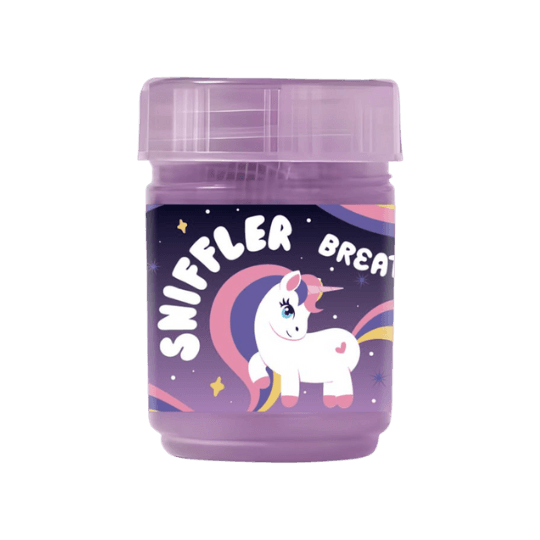
Sniffler is not a Thai product and is not sold as one. Its recipe draws on the East Asian herbal tradition and is its own composition.
There is genuine ingredient overlap, though: Sniffler also contains menthol (6%), eucalyptus oil (2%), borneol (2%) and mint/peppermint oil (1%) — four components that also appear in classic Ya Dom formulations.
The difference is the rest of the blend: 87% of Sniffler is dried plant material — perilla/shiso stems (20%), dried eucalyptus twigs (20%), hawthorn kernels (20%), knotweed vine (7%), licorice (7%), cinnamon twig (7%) and jasmine blossom (6%). It contains no camphor.
The full composition with exact percentages is on every product page and in the FAQ — we keep it openly visible on purpose.
Common questions
Is a herbal inhaler the same as a nasal spray? No. A decongestant nasal spray from the pharmacy contains actives such as xylometazoline or oxymetazoline. Sniffler contains no decongestant actives and is not a medicinal product.
Is anything burned or vaporised? No. There is no combustion, no smoke and no vapour — you simply smell the herbs and essential oils inside.
Does Sniffler contain nicotine, caffeine or sugar? No, none of them.
Curious about Sniffler?
100% plant-based, no nicotine, no caffeine, no sugar. The full ingredient list with exact percentages is on every product page.
Sniffler is a plant-based lifestyle product, not a medicinal product. This article is general information and not medical advice.