No Caffeine, No Sugar: What People Reach For Instead of Energy Drinks
“Caffeine-free pick-me-up” is one of those search phrases that has quietly become far more common. There is rarely a grand theory behind it — usually just a practical question: what do I reach for when I don't want an energy drink, a coffee or anything sweet? This article sorts the categories that actually exist, explains what is genuinely declared on an energy drink can, and places a scent-based product like Sniffler within that picture. One thing up front: we don't claim that any of it wakes anyone up.
“Caffeine-free pick-me-up” — a search term, not a promise
Phrases like “caffeine-free pick-me-up”, “energy drink alternative” or “no sugar, no caffeine” don't really describe an effect at all. They describe an ingredient list — mostly what should not be in it.
That distinction matters to us, so it goes right at the top: we make no claims about what any of the products mentioned here do — not water, not tea, not chewing gum, and not Sniffler.
What can be compared cleanly: composition, format, price, availability, and whether something is swallowed or not. That's what this article sticks to.
Why people say they skip caffeine or sugar
Ask around and the answers are rarely dramatic. Taste comes up most often: plenty of people simply don't enjoy heavily sweetened drinks.
A second common reason is the clock. Some stop drinking anything caffeinated from early afternoon onwards — a personal habit that settled in at some point.
Third: the way someone eats. If you generally keep sugar low, sweetened drinks tend to be the first thing to go, without any special reason behind it.
Some avoid caffeine after talking to a doctor, for example during pregnancy or while breastfeeding. That is an individual matter between a patient and their doctor — we deliberately offer no view on it.
And then there is the purely practical reason: the situation. In a meeting, on a train, in a library or on a bike, an open can is just awkward. Not every avoidance is a conviction; sometimes it is only logistics.
What's on the can — and how to read it
If you choose deliberately, the label is where you start. In the EU, drinks containing more than 150 mg of caffeine per litre must carry the notice “High caffeine content. Not recommended for children or pregnant or breast-feeding women”, along with the caffeine content in mg per 100 ml (Food Information Regulation (EU) No 1169/2011).
Outside the EU that regulation does not apply directly: Switzerland, the UK and Norway each have their own rules, some of them worded comparably. If you are buying there, check the requirements currently in force in your market — the wording and the reference quantity on the pack can differ.
Sugar appears in the nutrition table, usually per 100 ml. Scale it up to the can size — 250 ml, 330 ml and 500 ml differ substantially. Depending on the brand, a classic 250 ml can sits at roughly 80 mg of caffeine and around 27 g of sugar.
One point that often gets missed: “sugar-free” does not mean “caffeine-free”. Zero and light versions swap the sugar for sweeteners, while the caffeine usually stays. If you want neither, you have to change category, not just variant.
The categories that actually exist
Water is the least glamorous and most frequently named answer — still or sparkling, sometimes with lemon, cucumber or mint in the glass. Costs next to nothing and is available almost everywhere.
Tea is the second big category, with one important caveat: herbal and fruit infusions and rooibos are usually caffeine-free, whereas black tea, green tea and matcha are not. There are exceptions among herbal infusions too — mate and guayusa contain caffeine. “Tea” on its own is no guarantee; the packaging is worth a look.
Sugar-free chewing gum and pastilles make up the third category. They are typically sweetened with sugar substitutes such as xylitol or sorbitol, often in mint or menthol directions.
The fourth category is scent products — more on those below. And the fifth isn't a product at all: stand up, open a window, walk a few steps. We claim nothing about it, but it comes up so often that an honest list should include it.
Scent as a category of its own
“Scent ritual” covers quite a range: solid perfumes, roll-ons with essential oils, small scent tins, herbal inhalers. What they share is the format — something small that fits in a pocket and is used in seconds.
From an ingredients point of view the category is easy to place: nothing is swallowed, nothing is burned, nothing is vaporised. So there are no nutritional values, no sugar and no caffeine — not because anyone engineered them out, but because nothing is taken in at all.
What's left is the scent and a short, repeatable gesture. With these products the scent is typically intense and cool-spicy; how often and how long someone holds it to their nose is entirely up to them. We deliberately don't say more than that.
Where Sniffler sits on this list
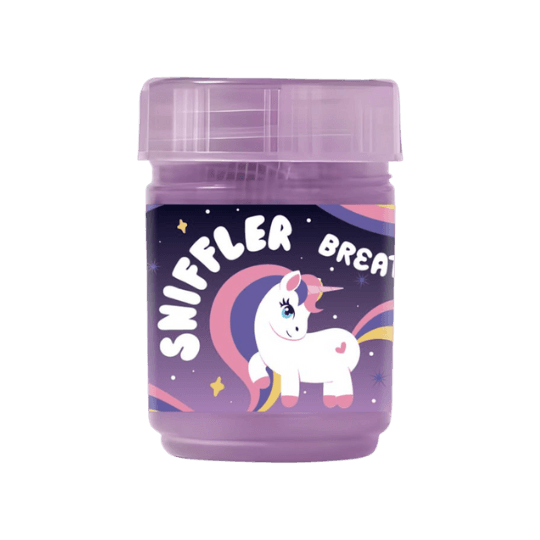
Sniffler is a 100% plant-based herbal inhaler: a small plastic container about 3.5 cm across and 5 cm tall, filled with dried herbs, flowers and essential oils. You open it and breathe in through the nose. No nicotine, no caffeine, no sugar — and it is not a medicinal product.
Around 87% of the blend is dried plant material: perilla/shiso stems 20%, dried eucalyptus twigs 20%, hawthorn kernels 20%, knotweed vine 7%, licorice 7%, cinnamon twig 7% and jasmine blossom 6%. The remaining 13% is menthol 6% (natural, distilled from peppermint stems and leaves), borneol 2%, eucalyptus oil 2%, rosemary oil 1%, mint/peppermint oil 1% and essential jasmine oil 1%.
A quick note on the licorice, since the name can be misleading: what's inside is the dried plant material — no added sugar and no licorice confectionery.
Pricing starts at €9.90 for a single unit, with larger packs cheaper per piece. Shipping covers the EU as well as Switzerland and the UK. Switzerland and the UK are not part of the EU customs union — customs duty and import taxes can apply on delivery there; the current rules are published by the relevant customs authority.
And the sentence that belongs here: we do not say that Sniffler replaces energy drinks or does anything at all. It appears on this list purely as a product without caffeine and without sugar whose composition is fully visible — every product page lists all percentages.
If you are pregnant, sensitive to strongly scented substances, or considering the product for children, speak to your doctor first. We deliberately give no recommendation on this.
Common questions
Is Sniffler an energy drink replacement? No. It's a different product category — you don't drink anything. The only meaningful comparison is on ingredients: no caffeine, no sugar, no nicotine.
Does Sniffler have calories or a nutrition table? No. Sniffler is not a food and is not swallowed, so there are no nutritional values to declare.
Does Sniffler contain sweeteners? No. The blend is dried plant material and essential oils, none of it sweetened.
Is Sniffler a Thai product? No. Thai Ya Dom inhalers are their own category. Sniffler shares individual components with them, such as menthol, borneol and eucalyptus oil, but contains no camphor and adds the dried botanicals listed above.
Curious about Sniffler?
100% plant-based, no nicotine, no caffeine, no sugar. The full ingredient list with exact percentages is on every product page.
Sniffler is a plant-based lifestyle product, not a medicinal product. This article is general information and not medical advice.